Travel · 7 min read
Towing a caravan to Spain:
routes, tolls, speed limits and the alternative
Towing a caravan to Spain: routes through France, tolls, Spanish towing speed limits and what to carry, plus the option to leave it stored here.
On this page
Towing a caravan to Spain is a long drive, but a straightforward one if you plan it. This guide covers the main routes to the Costa Brava from the UK, Ireland, the Netherlands, Belgium and Germany, what to know about tolls and speed limits, and a few practical points on the road. At the end we explain why many owners only make the full journey once and keep the caravan in Spain.
Rules on tolls, speed limits and required equipment change, and some depend on the weight of your outfit. Treat this as a planning guide and check the official sources for each country before you travel.
Routes to the Costa Brava
Our yard in Vilasacra is on the AP-7, the motorway that runs from the French border at Le Perthus down the Mediterranean coast. We are two minutes from exit 4, about 40 minutes after you cross into Spain. That makes the Costa Brava one of the easiest parts of Spain to reach by road from northern Europe.
From the UK and Ireland via the Channel
Most people cross from Dover or Folkestone to Calais, or take a longer crossing to a port further west. From Calais there are two main ways south:
- The eastern route: towards Reims, Dijon and Lyon, then down the Rhône valley on the A7 and along the coast on the A9 to the border. Mostly toll motorway, fast and well served with services, but busy on summer weekends.
- The central route: via Paris or around it, then south through Clermont-Ferrand on the A75 to Béziers, joining the A9. The A75 is largely free of tolls apart from the Millau Viaduct, but it climbs over the Massif Central, which is hard work for a heavy outfit and can see snow in winter.
Irish readers can sail directly to France, or cross to Wales and drive through the UK to a Channel port.
From the UK by ferry to northern Spain
Ferries run from England to Santander and Bilbao. This cuts out the drive through France, but you still have a long run across northern Spain to reach Catalonia. It suits some people well, especially those who dislike motorway driving in France, but compare the total cost and time with a short crossing.
From the Netherlands, Belgium and Germany
From the Netherlands and Belgium the usual line runs through Luxembourg, Metz and Nancy towards Dijon and Lyon, then the A7 and A9. From western Germany many drivers go via Strasbourg or Mulhouse to Beaune and Lyon. Southern Germans sometimes route through Switzerland, but check Swiss rules for trailers and the motorway vignette first.
Tolls
France: most French autoroutes charge tolls, and a caravan puts you into a higher class than a car alone. Prices vary by route and change each year, so use the operators’ own route calculators to estimate your costs. An electronic toll tag can save time queuing at barriers.
Spain: the AP-7 in Catalonia became toll-free on 1 September 2021, including the stretch from the French border past our yard. Some other Spanish motorways still charge, so check if you are continuing further south.
Speed limits in Spain when towing
For a car towing a caravan in Spain, the limits are:
- 80 km/h on motorways (autopistas and autovías) and dual carriageways
- 70 km/h on other roads
- lower where signs say so, and in towns
Limits can differ for heavier outfits and for motorhomes over 3,500 kg, and France has its own rules. Check the official Spanish traffic authority (DGT) and French government sites for the rules that apply to your vehicle and weight.
What to carry
Requirements differ by country and by where your vehicle is registered. As a starting point, check that you have:
- driving licence, vehicle and caravan registration documents, and insurance that covers towing abroad
- the correct country identifier (for UK vehicles, a UK sticker unless the number plate already shows the UK identifier)
- a reflective jacket for each occupant, kept inside the car, and warning triangles or other warning devices as required
- towing mirrors if the caravan is wider than the car’s own mirrors allow you to see past
- spare bulbs, and headlamp beam adjustment if your car needs it
- a Crit’Air sticker if your route takes you into French low-emission zones
The GOV.UK “driving abroad” pages, the RAC and AA, and national motoring clubs such as the ANWB and ADAC publish up-to-date checklists for their members.
On the road
- Load carefully: heavy items low and over the axle, and check the noseweight.
- Plan stops: two full days from Calais is comfortable for most people. Pushing it into one long day with a caravan is tiring and not worth the risk.
- Watch the wind: the Rhône valley and the approach to the Pyrenees can be very windy. Slow down in strong crosswinds.
- Avoid peak weekends: French motorways are at their worst on Saturdays in July and August.
The alternative: tow it once, then leave it here
Towing from Belgium or the Midlands and back again for every holiday means two long drives a year, and the tolls, fuel, ferries and overnight stops add up quickly, before you count the wear on the car and the caravan.
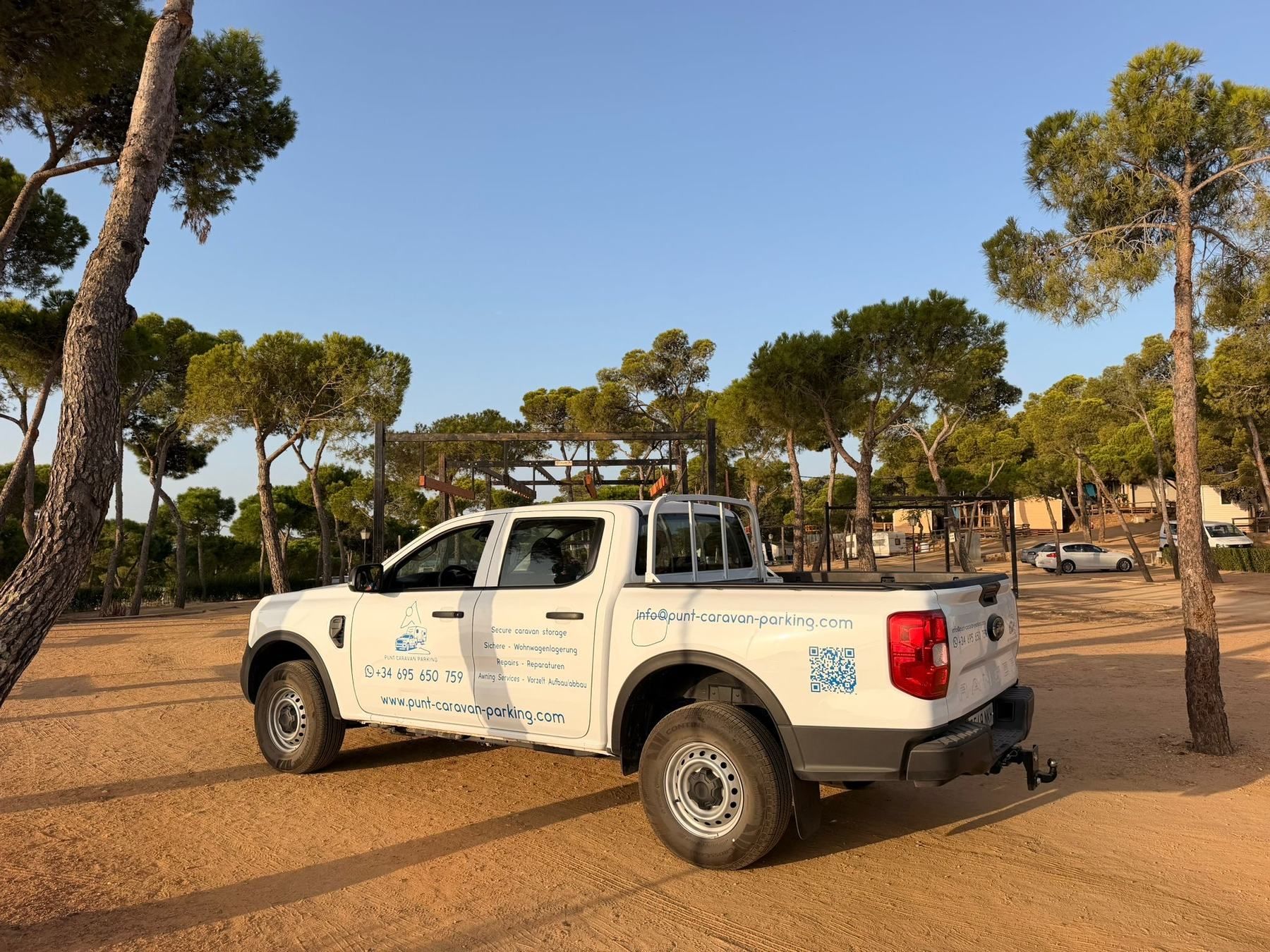
The alternative is to tow the caravan down once and keep it in Spain. Between trips it stays with us in Vilasacra; when you come on holiday you fly or drive down without it, and we deliver it to your campsite. At the end of your stay we collect it and bring it back to storage. Zones and prices for campsites in Castelló d’Empúries, Empuriabrava, Sant Pere Pescador, L’Escala and Roses are on our transport services page, and storage prices are on storage pricing.
We look at the numbers in more detail in what caravan storage costs on the Costa Brava.
Ready when you arrive
If you are planning the drive down and want a space waiting at the end of it, tell us your arrival date and caravan length through our contact page. We are open Monday to Saturday 09:00 to 17:00 and Sunday 10:00 to 13:00, and drop-offs are by appointment.